Frugal AI · Indian edition November 2026 · UK, Europe & North America 2027
Artificial intelligence is moving into institutions faster than institutions are learning how to hold it.
Frugal AI examines the distance between what AI can do and what an institution can responsibly absorb, and the architecture required to close it.
“Rare operational honesty”
Audrey Tang, co-author of Plurality; Cyber Ambassador of Taiwan
Advance praise also from Carlota Perez, Diane Coyle, Vivek Lall, Navi Radjou, Kentaro Toyama and twelve others
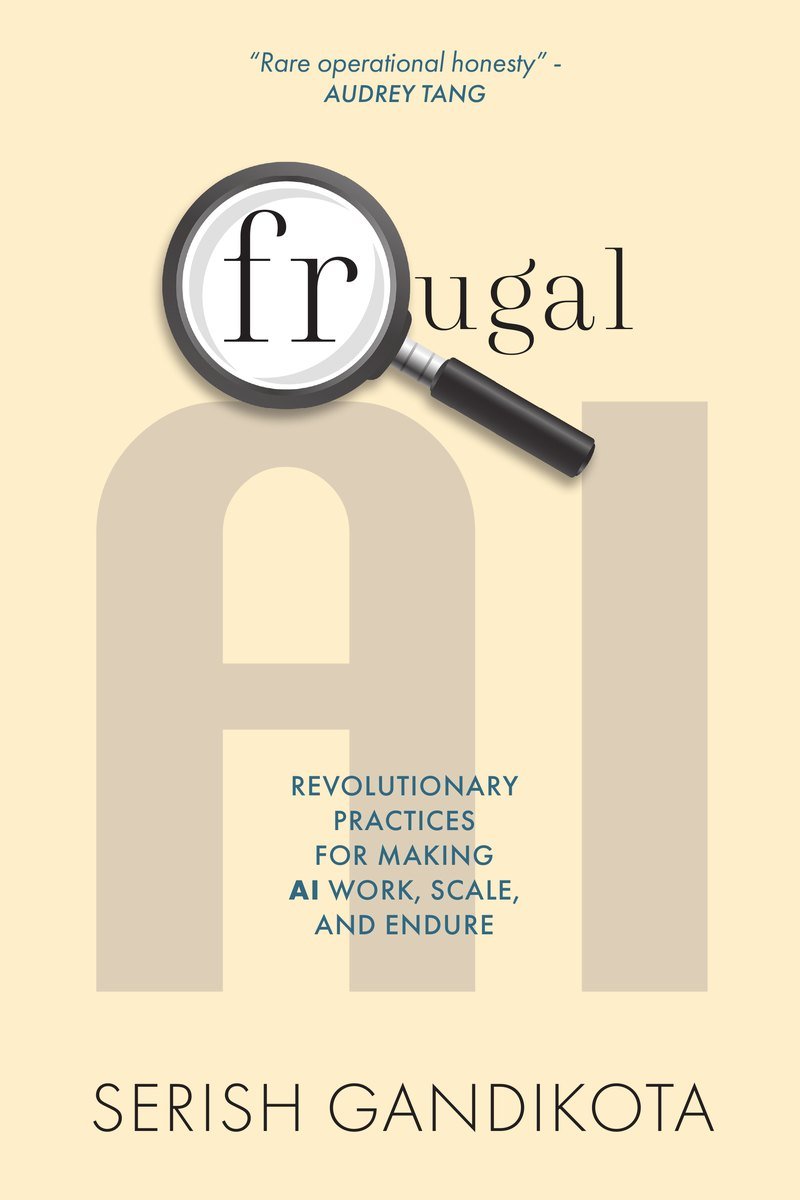
Serish Gandikota · Global Resilience Publishing
The argument
AI creates lasting value when institutions are designed to hold it.
Across sectors, capability arrives, workflows strain and costs surface. Systems that performed impressively in demonstration become difficult to sustain in practice. The decisive variable is increasingly the distance between what AI can do and what an organisation can responsibly absorb.
The pattern appears wherever AI moves from pilot to production. An NHS trust finds that a clinical documentation system was never costed for routine use across its wards. A European manufacturer learns that AI quality control built for a stable cloud connection breaks when shop-floor connectivity fluctuates. Enterprise teams discover that running models continuously across real workflows costs an order of magnitude more than their pilots suggested.
MahaVISTAAR, Maharashtra’s voice-based agricultural advisory system, shows what deliberate design makes possible. Built for the conditions it would actually operate in, it reached roughly 2.5 to 3 million farmers by early 2026, and the documented decisions behind it allowed teams to adapt it for Ethiopia in three months and for Amul’s dairy cooperative in three weeks.
“Adoption is often confused with absorption. The difference is the difference between adopting a child and raising one.”
From the Prologue
The frameworks
Five complementary lenses
Frugal AI is the design philosophy. These lenses are complementary ways of seeing what it requires.
01 · Prior condition
Sufficiency Test
Does this workflow require AI at all?
02 · Diagnostic
Absorption Gap
The distance between what a system can do and what an institution can sustain.
03 · Design framework
Frugal Stack
Five layers (compute, model, data, orchestration, governance) that must align for a system to hold.
04 · Economic methodology
Total Cost Architecture
How design choices create, move, and amplify cost across the Stack, including the layers procurement leaves uncosted.
05 · Positioning practice
Sovereign Spine
At each layer of the Stack: what must be controlled, what can be influenced, what may safely be rented.
The final test
- Can the system survive the environment in which it will operate?
- Can the institution govern it?
- Can economics hold at scale?
- Can the system adapt when conditions change?
- Can it keep working if the original vendor, consultant or project team is no longer there?
Advance praise
Eighteen voices across technology, economics, policy and practice
Open any card to read the full endorsement.
“Rare operational honesty—down to the 8,000-rupee handset that is actually in use.”Audrey Tang
Co-author of Plurality; former Digital Minister; now Cyber Ambassador of Taiwan
Plurality does not need one superintelligent centre of gravity; it needs millions of bounded, accountable systems that institutions can actually hold. Frugal AI shows, with rare operational honesty—down to the 8,000-rupee handset that is actually in use—how that holding is done. A design philosophy for keeping judgment where it belongs: with the people closest to the consequences.
“A bold and serious effort at connecting the most powerful technology at hand with the most urgent challenge facing humanity.”Carlota Perez
Author of Technological Revolutions and Financial Capital: The Dynamics of Bubbles and Golden Ages; Honorary Professor, University College London, U.K.
As is the case with every revolutionary technology, society will shape the direction taken by artificial intelligence. This book is a bold and serious effort at connecting the most powerful technology at hand with the most urgent challenge facing humanity. A must read!
“This exciting book explores the lessons of frugal innovation for AI.”Professor Dame Diane Coyle
Bennett Professor of Public Policy and Research Director, Bennett School of Public Policy, University of Cambridge, U.K.
AI will only live up to its promise if it is used – and used in ways that benefit the world as a whole. This exciting book explores the lessons of frugal innovation for AI, bringing those rich insights to the current technological moment.
“Asks the question every board will eventually have to answer: can we actually hold this together?”Dr Vivek Lall
CEO, General Atomics Global Corporation, USA
In aerospace and defence, we learn early that the price of acquiring a capability tells you almost nothing about the cost of sustaining it. Serish Gandikota brings that discipline to artificial intelligence with unusual clarity in Frugal AI. He treats deployment as an engineering and institutional problem rather than a procurement event, and in doing so asks the question every board will eventually have to answer: can we actually hold this together?
“All CEOs and policymakers should read this seminal guidebook.”Navi Radjou
Co-author of Frugal Innovation; Thinkers50-ranked management expert; USA
This remarkable book shows how organizations and nations can unlock and harness AI’s full socio-economic potential without breaking the bank. Serish Gandikota outlines a frugal and robust design philosophy for implementing AI strategically in businesses and public institutions so they can maximize impact and minimize waste. The winners in the 21st century will not be institutions that invest in ‘bigger and better’ AI models but the ones that invest in the right organizational capabilities to absorb AI’s transformative power effectively. All CEOs and policymakers should read this seminal guidebook to learn how to master AI adoption cost-effectively and achieve durable benefits.
“A timely and important book!”Kentaro Toyama
Author of Geek Heresy: Rescuing Social Change from the Cult of Technology; W. K. Kellogg Professor of Community Information and Professor of Information, School of Information, University of Michigan, USA
Technology for the most part only amplifies human and institutional forces, and Frugal AI shows what this means for artificial intelligence: for organizations to see durable value from AI, they need not only the technology, but the ability to absorb, govern and sustain it. A timely and important book!
“A clear and practical blueprint for building AI systems that are efficient, resilient and genuinely inclusive.”Professor Jaideep Prabhu
Co-author of Frugal Innovation; Jawaharlal Nehru Professor of Indian Business and Enterprise, Professor of Marketing, and Director of the Centre for India and Global Business, Judge Business School, University of Cambridge, U.K.
It is amazing to see the principles of frugal innovation carried into the age of artificial intelligence in this compelling book on Frugal AI. By treating constraint as a design strength and focusing on deployment in real institutional settings, the book offers a clear and practical blueprint for building AI systems that are efficient, resilient and genuinely inclusive.
“Addresses the highly discussed topic of AI from a completely new and highly pragmatic angle.”Dr Stephanie Knizkov
Head of Digital Transformation Steering at Fortune 100 Automotive OEM, Germany
An important book that addresses the highly discussed topic of AI from a completely new and highly pragmatic angle. It articulates what engineers and executives in manufacturing firms have witnessed firsthand; that model or human capability was never the binding constraint on AI transformation, institutional absorption was. The frameworks proposed in the book, such as the “Frugal Stack” and the “Sufficiency Test”, give this insight the discipline of methods; one which every industrial AI initiative should be made to satisfy before it reaches the shopfloor.
“A valuable guide for leaders, policymakers, and practitioners navigating the deployment era of AI.”Dr Jacki O’Neill
Director of Microsoft Research Africa, Kenya
At a time when AI discourse centres on wowing the public with new frontier model capabilities, Frugal AI offers a refreshing shift in perspective. Drawing on examples from public services, agriculture, and resource-constrained environments, Serish Gandikota shifts the conversation from model capability to the harder challenges of deployment, governance, and institutional readiness. The result is a compelling framework for confronting the complexities of how AI might be absorbed into organisations and a valuable guide for leaders, policymakers, and practitioners navigating the deployment era of AI.
“Companies that truly want to make the most of AI would do well to take this to heart.”Liza Wohlfart
Head of the Center for Frugal Products and Manufacturing Systems at Fraunhofer Stuttgart, Germany
This book arrives at a time when many organisations feel stuck. AI can do so much, yet they struggle to encourage their staff to use it to its full potential. Or so they believe. Too often, implementation begins before the most basic questions have been asked: What do we actually need? And do we need AI at all for the specific task at hand? Serish Gandikota, a pioneer of frugal innovation, offers practical tools for approaching AI in a smart way, while challenging the widespread misconception that frugality is about cutting costs. It is not. It values simplicity as a design principle that increases robustness and ease of use. As Serish puts it, “Cheapness lowers standards; frugality raises them.” Companies that truly want to make the most of AI would do well to take this to heart. This book is a wonderful starting point.
“A holistic framework for creating AI that is more resilient, more inclusive, and ultimately more impactful.”Deepa Prahalad
Co-author of Predictable Magic: Unleash the Power of Design Strategy to Transform Your Business; CEO, Anuvaa LLC; USA
Frugal AI reminds us that the best innovations aren’t the ones designed for ideal conditions—they’re often the ones designed to succeed under real ones. Instead of asking, “What can AI do?” Serish asks whether AI is designed for the people, institutions, and environments it is meant to serve. In treating real-world constraints as opportunities for better design, he offers a holistic framework for creating AI that is more resilient, more inclusive, and ultimately more impactful.
“An empowering and practicable framework for making AI more frugal, more sustainable and ultimately, more ethical.”Dr Sun Sun Lim
Author of Humanising Technology: Reflections on Design, Ethics and Inclusion; Professor, Singapore Management University, Singapore
As the world continues to grapple with the escalating costs and steep resource demands of technology, Serish Gandikota offers an empowering and practicable framework for making AI more frugal, more sustainable and ultimately, more ethical.
“A genuinely useful diagnostic for anyone responsible for making these decisions.”Ravi Bhalla
Director of Strategy and AI, M&G, U.K.
Anyone who has worked through large vendor and technology transformations knows the model or platform is rarely the hard part. Governance, orchestration and cost discipline are. This puts it into a robust framework, and the Absorption Gap does well to consider the broader organisational operating model, not just the technology sitting on top of it. A genuinely useful diagnostic for anyone responsible for making these decisions.
“Clarity, practical case-studies, and hard-won experience.”Tokunboh Ishmael
Co-founder & Managing Director of Alitheia Capital, Nigeria and U.K.
The initial frenzy around AI is subsiding, and business owners are now asking the harder question: what does adoption really cost, and what does it really return? How does AI build resilience and efficiency? How do you move from adopting AI to embedding it without killing the golden goose? And how do global majority businesses build AI systems right-sized for their realities, without the budgets of their deep-pocketed northern counterparts? Serish explores this and more with clarity, practical case-studies, and hard-won experience.
“Excellent reading for companies that want to understand how to reap the benefits of AI in the most resource-efficient way.”Sean Randolph
Senior Director, Bay Area Council Economic Institute, USA
Serish Gandikota’s insightful book brings an important message at exactly the right time. The obsession with the power of LLMs, a field where only a few can play, is giving way to the need to understand how AI can be most effectively used. As Gandikota points out, this is not only a question of deployment but of absorption, the institutional capacity to find the right fit for an organisation’s specific needs, a managerial gap that is clear in both business and government. His book is excellent reading for companies that want to understand how to reap the benefits of AI in the most resource-efficient way.
“Not who uses AI, but who has the capacity to determine how it is used.”Parminder Vir OBE
U.K.
Across Africa, I have seen successive waves of technology arrive with the promise of transformation. Serish Gandikota’s distinction between adoption and absorption therefore resonates deeply. With AI, the challenge is not simply to adopt another technology, but to build the capacity to own, shape, govern and sustain AI. Frugal AI asks the more important question: not who uses AI, but who has the capacity to determine how it is used.
“An important and timely contribution to the conversation about how we turn the promise of AI into meaningful impact.”Sonia Singh
Author of Defining India: Through Their Eyes; Founder & CEO, SSA India
The real test of AI is not just what the technology can do, but how well it can work in the real world and change people’s lives for the better. Serish Gandikota’s Frugal AI is an important and timely contribution to the conversation about how we turn the promise of AI into meaningful impact.
“Essential reading for anyone seeking to build systems that can sustain AI’s promise.”Dr Kristian Olson
MD, MPH, DTM&H; Leader of Design Impact at the Springboard Studio, Mass General Brigham Health; Associate Professor of Innovation and Clinical Expertise, Harvard Medical School, USA
Serish Gandikota’s Frugal AI offers a vital design philosophy for turning powerful AI technology into lasting, broadly shared value. From my perspective in healthcare, his distinction between adoption and absorption resonates deeply as we struggle to move from pilots to functioning infrastructure. His warning about accumulating unintended dependencies deserves our attention. This book is essential reading for anyone seeking to build systems that can sustain AI’s promise.
Get book and launch updates
Hear when Frugal AI is published in your region, and about launch events and talks near you.
Your details are used only for these updates and are never shared.
Get the book
Indian edition first, international edition in 2027
Indian edition · November 2026
Launching in Bengaluru on 18 November 2026. Distributed in India and South-East Asia by Penguin Random House India.
Paperback Rs 799 · Hardback Rs 1,295
Retailer links will be added here as listings go live.
UK, Europe & North America · 2027
Published by Global Resilience Publishing, Cambridge.
Paperback £16.99 · US$22.99 · CA$29.99 · A$34.99
Hardback £25.00 · US$32.00 · CA$39.99 · A$55.00
For bulk orders or copies for an event, get in touch.
Hardback ISBN 978-1-913738-77-8 · Paperback ISBN 978-1-913738-86-0 · 242 pages · Also as e-book and audiobook · Publisher’s page
Launch events
Meet the author
18 November 2026
Bengaluru book launch, hosted by EkStep (People+ai)
24 Nov – 12 Dec 2026
University talks across India
To host a talk, seminar or book event, see Speaking.
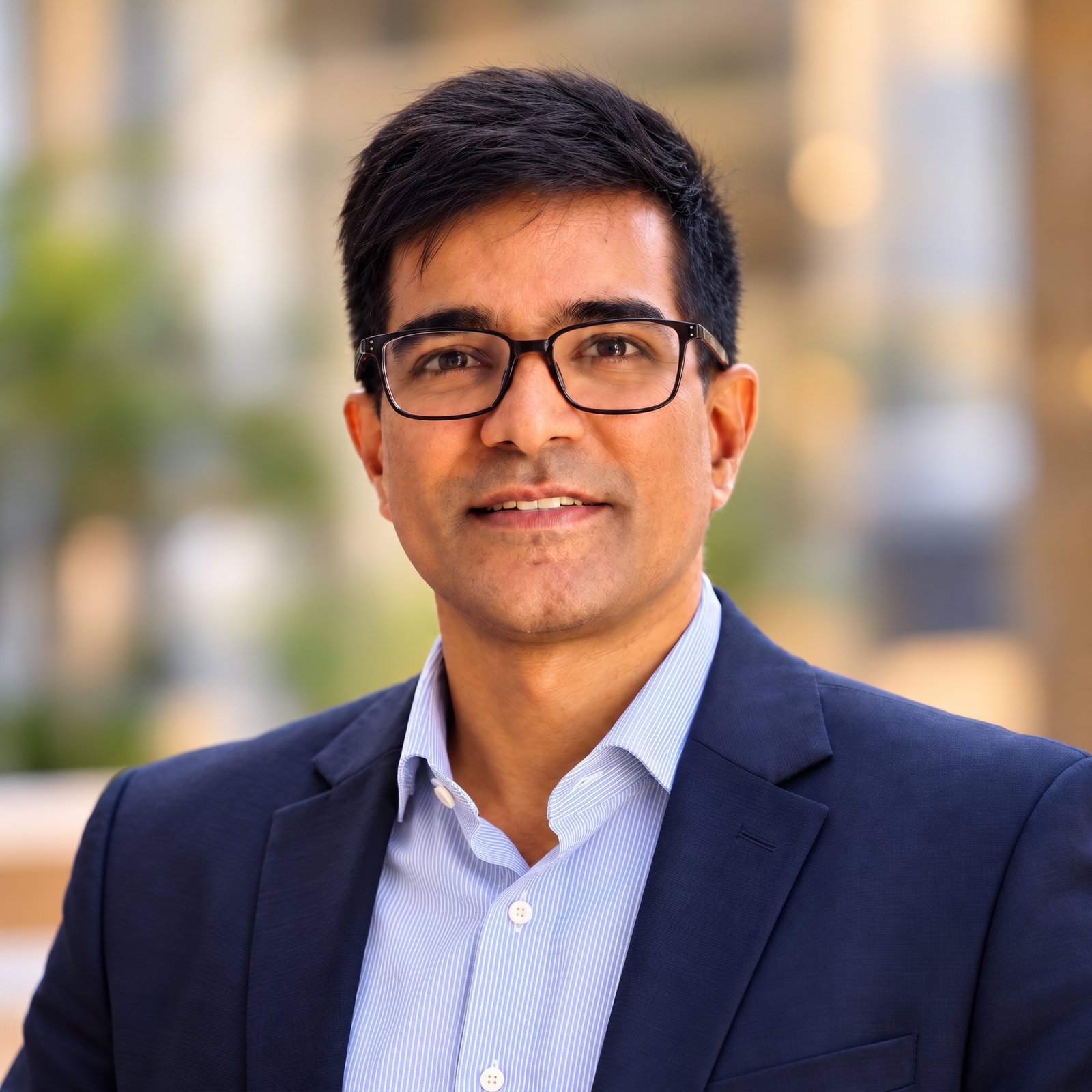
About the author
Serish Gandikota
Serish Gandikota is an Honorary Fellow at Cambridge Judge Business School, where he leads the Frugal AI Deployment Labs, a programme within the Frugal AI Hub, which he co-founded and co-leads with Elizabeth Osta. The Hub works with governments, public institutions and companies on designing and deploying AI under real-world constraints of cost, computing power, infrastructure, energy, organisational capacity and governance. Its research partners include the United Nations International Computing Centre.
For more than a decade his work has spanned frugal innovation, technology deployment and impact investing across Europe, India and Africa. He spoke on Frugal AI at the inaugural SXSW London in 2025, co-founded InnoFrugal in Finland, and is a Fellow of the Royal Society of Arts.